



Strike a Chord Appeal Deep Dive
Gain an insight into Starstruck’s score from some of the key players.
- Christopher Hampson, CEO/Artistic Director & Starstruck’s choreographer
- Martin Yates, Principal Guest Conductor of the Scottish Ballet Orchestra, who reorchestrated Starstruck’s score
- Bruno Micchiardi, Principal, who will be performing the role of the choreographer in Starstruck
- Lynda Cochrane, piano Soloist for Starstruck
The Starstruck score consists of:
ACT 1
Maurice Ravel (1875-1937)
Concerto for piano and orchestra in G major (1929–31)
I Allegramente
II Adagio Assai
Maurice Ravel (1875-1937)
La valse, poème choréographique (1919–20)
Mouvement de valse viennoise
ACT 2
Frédéric Chopin (1810–1849)
Orchestrations (1936) by Roy Douglas (1907-2015)
Nocturne, Op.32, No.2 in A-flat major.
Waltz, Op. posth. 70, No. 1 in G-flat major
Grande Valse Brillante, Op.18 in E-flat major
Prelude, Op.28, No. 7 in A major
George Gershwin (1898–1937)
Concerto in F (1925)
I Allegro
II Adagio – Andante con moto
III Allegro agitato
The story of Starstruck:
Gene Kelly was the first American choreographer to premiere a ballet, Pas de Dieux, at the Paris Opera Ballet. This piece forms the final 25 minutes of what we now know as Starstruck. We honour his creative legacy with the return to the stage in 2026, enhanced and extended.
In collaboration with Gene Kelly’s widow, Patricia Ward Kelly, Scottish Ballet lovingly revived the original ballet in 2021, but just after the pandemic, theatres were not allowed an interval so the piece was only an hour long. In this new two-act Starstruck, CEO/Artistic Director, Christopher Hampson CBE, builds on a love story between a Star Ballerina and a Choreographer, and their mythological counterparts, Aphrodite and Zeus.
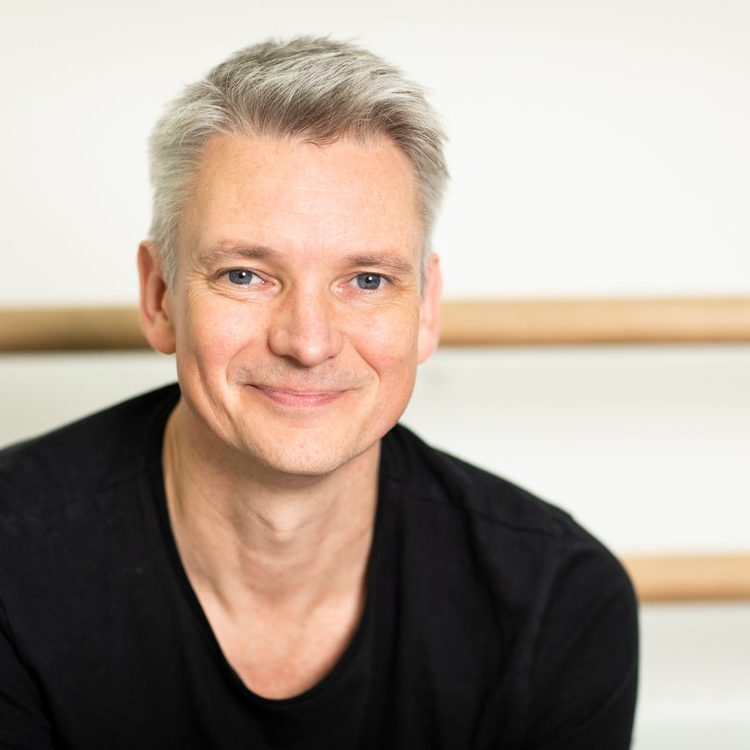
Christopher Hampson, Scottish Ballet CEO/ Artistic Director
What difference does live music make to a performance?
It makes all the difference and especially for this one. Live music brings the theatre to life. The audience, the kids especially, run to the front to look at the instruments in the pit, I love that.
What is the impact of live music on the dancers’ performance?
The dancers feel like their performance is being partnered; the dancers and the musicians all know each other and work together as a team. The musicians always cheer the dancers on; they want them to give their best performance, especially if the dancers are performing a new role or if they have just joined the company. It’s extra special in Aberdeen when the orchestra can pretty much see the stage – that’s one of the reasons we love play at His Majesty’s Theatre. Martin Yates, Principal Guest Conductor, is brilliant at communicating to the musicians what is happening on stage. Live music adds magic to the performance in a theatre; the audience participates along with music and dancers, and that’s hundreds of people every night. That’s amazing, I love every second of it.
I studied piano for a long time, so I know it’s important to leave space for the pianist’s notes in the choreography; we need to remember the pianist is an artist doing their own performance. I leave space for interpretation for both dancer and musician, and try not to over-choreograph.
What should the audience watch or listen out for in Starstruck?
In the new section of Act 1, the second movement of the Ravel piano concerto, it’s a melancholic, beautiful, heart-rendering tune, so simple it’s a real work of genius. It’s about seven minutes long, really showcasing the ballerina and the choreographer together. The audience should also listen out for La Valse, in the second half of Act 1 – it’s my favourite piece of music in this score.
Gershwin and Ravel’s pieces were written at a similar time. Apparently, Gershwin asked Ravel if he could study with him. Ravel’s reply was, ‘Why be a secondary Ravel when you can be a first-rate Gershwin?’
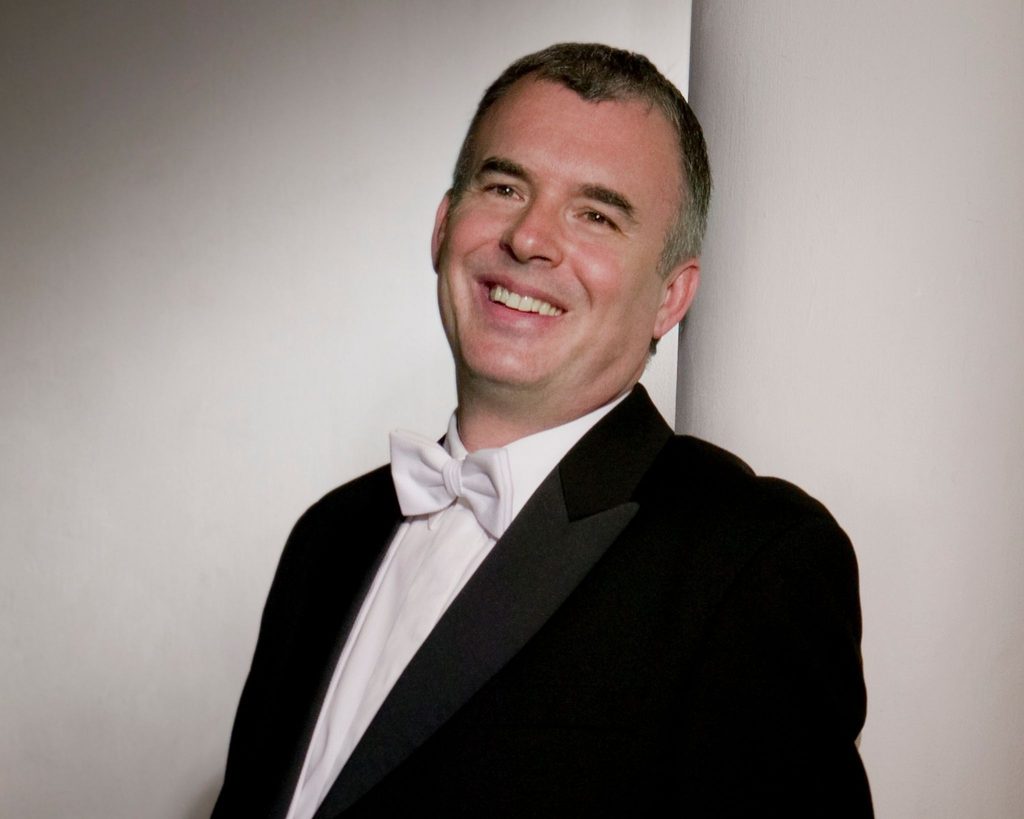
Martin Yates- Principal Guest Conductor
How do you re-orchestrate a score for a new production and what is the process?
Gershwin’s piano Concerto in F and Ravel’s La Valse were written for a colossal orchestra – about 70 musicians. That number of people simply won’t fit into the pit at most theatres, when we also need to fit in a 9-foot grand piano. My job in re-orchestrating the score was to reduce the number of musicians to 56 and rebalance the orchestra so the full sound is still there, but the notes may differ slightly from the original. It is also important to make sure the piano isn’t drowned out by the orchestra, so that was an extra challenge. The four pieces were composed as stand-alone pieces; re-orchestration will provide audio consistency. In the process, I am making sure not to lose the composer’s original intentions. I love French music, and Ravel is one of my favourite orchestrators and a complete genius!
What is the most enjoyable part of your job?
Whatever I am conducting today. I start the season with a pile of scores two feet high on my desk, look at them bit by bit and apply myself to learning them. Re-orchestrating an existing score can take me a year to get my head around; how it sounds, how it’s meant to sound, what the composer wanted. I had a great teacher who taught me, ‘I don’t count, it’s about the music.’ It frustrates me when colleagues say ‘My Brahms’ because, in my view, we are interpreters of the original piece. We can choose a long or short accent, but the music never becomes mine. We are facilitators. I help the musicians and enjoy the collaboration, but mostly I just want people to be free to play; I often leave it to them to try things. I ask them to surprise me instead of telling them what to do. They have some great ideas!
How is working with ballet different from opera?
It is always stricter. Certain things have to happen at a certain time for a jété or a lift. I mentor aspiring conductors and tell them that ballet is the hardest thing they will ever do. You are tempo- dependent – the music simply can’t move faster or slower than the steps on stage. On the other hand, it can never be exact because neither the musicians nor the dancers are robots. It’s a hard discipline. As a conductor, you can make or break the evening by leaving too long a gap between the sections. That’s the theatre of it, and you have to keep a sharp focus for the entire evening to make for the best performance. It is very rewarding though, and the music is extraordinary. Romeo & Juliet, Rite of Spring, Swan Lake, The Nutcracker, are all amazing scores. When you have a committed orchestra, it’s great! And I love that all musicians are playing throughout the performance unlike opera, where there can be long breaks.
From your position, how much can you see on stage? The rostrum is quite high, and I don’t like sticking up above the audience; I feel like I am in the way. But I need to see enough to guide the musicians. Sometimes dancers move so quickly that we can’t play the note in time. If I had a seat, I would be on the edge of it the whole night. The reward is the applause at the end; it’s such a great feeling when we have managed to deliver another great performance together with the dancers.

Bruno Micchiardi – Scottish Ballet Principal
How does performing to live music differ from dancing to a recording?
Live music can affect a performance a lot; it makes the show very collaborative, you’re not just performing to a pre-set tempo or sound, but instead really listening to the music it almost becomes another dancer within the choreography. Live music is inspiring to dance to and it helps us add another level to our performance. We want to do our best to deliver for the audience and do justice to the musicians’ hard work too.
You previously played Eros in the production. What are you most excited about for your new role as the choreographer in Starstruck?
It’ll be a new challenge in a very special ballet, and very different to the role of Eros. I look forward to working with Chris on expanding the ballet.
Do you play an instrument yourself or have you done so in the past? I’ve played many instruments in the past; guitar, violin, piano, flute, but I can’t say I have a particular affinity for any of them, which is probably why I went down the route of being a dancer!

Lynda Cochrane – Piano Soloist
How did you get into music?
I started playing at the age of four. I did go to ballet classes at that time too, but instead of going up, my marks went down each year! I remember seeing The Nutcracker at age seven and being fascinated by the celeste instrument for the dance of the Sugar Plum Fairy. I have played the celeste often, including The Nutcracker. The social aspect and collaboration drew me into piano and orchestras. With Scottish Ballet, the whole team, including lighting, costumes, etc., it all comes together on stage, and you feel a real part of it. We will be a bit squeezed in the pit – which is tricky with the smaller theatres in Inverness and Aberdeen, but we always manage. The piano will have the lid off for Starstruck, so the sounds can travel up to the audience and the dancers.
Can you tell us about your music education?
I went to a regular secondary school rather than a music school and then to Manchester University for a joint degree course. From there, I went to the United States for a scholarship at Indiana University, came back to Scotland and played with the BBC Orchestra, Royal Scottish National Orchestra and the Paragon ensemble. I worked hard, I happened to be in the right place, at the right time and made sure I did a good job every time I performed. I think that helped me in the earlier stage of my career.
What has your experience been with the score for Starstruck so far?
I was invited to be the soloist for the Starstruck score, and I was delighted to accept. The music is so uplifting and puts a smile on your face. If you listen to it on a bad day, you will feel like you have escaped. It’s a bubble of joy and exuberance, the orchestration is so rich, and it’s a lovely showcase for the SB orchestra with gorgeous solos for the harp, trumpet, flutes and violins. The pit is a real jewel box of talented musicians; everyone is giving it their all, they will sparkle during performances and that energy will be felt by the dancers.
It’s lovely for the orchestra to get to play something like this, yes, it’s tricky, but so rewarding. The audience will feel the punchy rhythm through their feet and the textures and experience Gershwin and Ravel’s different styles. Ravel is like a very sophisticated French cake; a light choux bun with a pop of flavour in the smooth creamy feeling – it’s unexpected.
How do you prepare for the tour?
Getting ready for the tour has taken months of preparation, and there is more to come. I originally learned the Ravel as a student and then Gershwin in lockdown for the first version of Starstruck in 2021. Finger placements can be done in different ways, and it takes time to perfect. My aim is to have it so well remembered in my fingers that I can react to whatever the conductor does, every small delay in a move, or an unexpected situation. It needs to be that secure.
How do you deal with the pressure of performing as Soloist for the orchestra?
As Soloist, there is definitely pressure to get it right. I tell myself I just have a few more notes than anyone else. Once I start to play, it all falls into place, and it’s just wonderful to feel part of that amazing team effort. Concertos are physically challenging, and it really helps to have a good level of fitness. Luckily, I am a runner, so I was one step ahead!

